
How to Start an Online Business in 2026 (Without Spending Hundreds of Dollars a Month)
If you've been Googling "how to start an online business," you've probably been overwhelmed.
One creator tells you to buy Kajabi.
Another recommends Stan Store.
Someone else says you need ClickFunnels, ConvertKit, ManyChat, a website, a CRM (what is that even? 😬), an email platform, and five different subscriptions before you can even make your first sale.
Before you've earned your first dollar, you're already spending hundreds every month.
For most beginners, it starts feeling less like a business and more like an expensive hobby.
I don't think that's necessary.
In fact, if I were starting over today, I'd build almost everything on Skool. My goal would be to make my first sale as quickly and inexpensively as possible.
Table of Contents
• Why I Recommend Skool
• Step 1: Create One Offer
• Step 2: Deliver Your Product
• Pro Tip: Build a Free Community
• Real Life Examples
• Step 3: Skip the Email Platform (For Now)
• Step 4: Get Traffic
• When It's Time to Upgrade/Add to Your Toolbox
• My Beginner Tech Stack
• My Advice If I Were Starting Today
Why I Recommend Skool
For just $9/month (or $90/year), Skool gives you almost everything you need to launch.
Instead of paying separately for:
A course platform
A community platform
Product delivery
A landing page
Member management
...it's all in one place.
Simple beats complicated when you're just getting started.
Step 1: Create ONE Offer
Don't build five products.
Don't build three memberships.
Don't build an entire course library.
Create one thing that solves one problem.
Examples:
A PDF
A workbook
A checklist
A mini course
A template pack
A challenge
Done is better than perfect.
The $9 Business Blueprint
If you remember nothing else from this guide, remember this.
Most beginners don't fail because they aren't smart enough.
They fail because they build five things at once.
A website.
An email funnel.
A lead magnet.
Three offers.
A YouTube channel.
A podcast.
Before they've made their first sale.
Keep it simple.
Your first online business only needs one clear path.
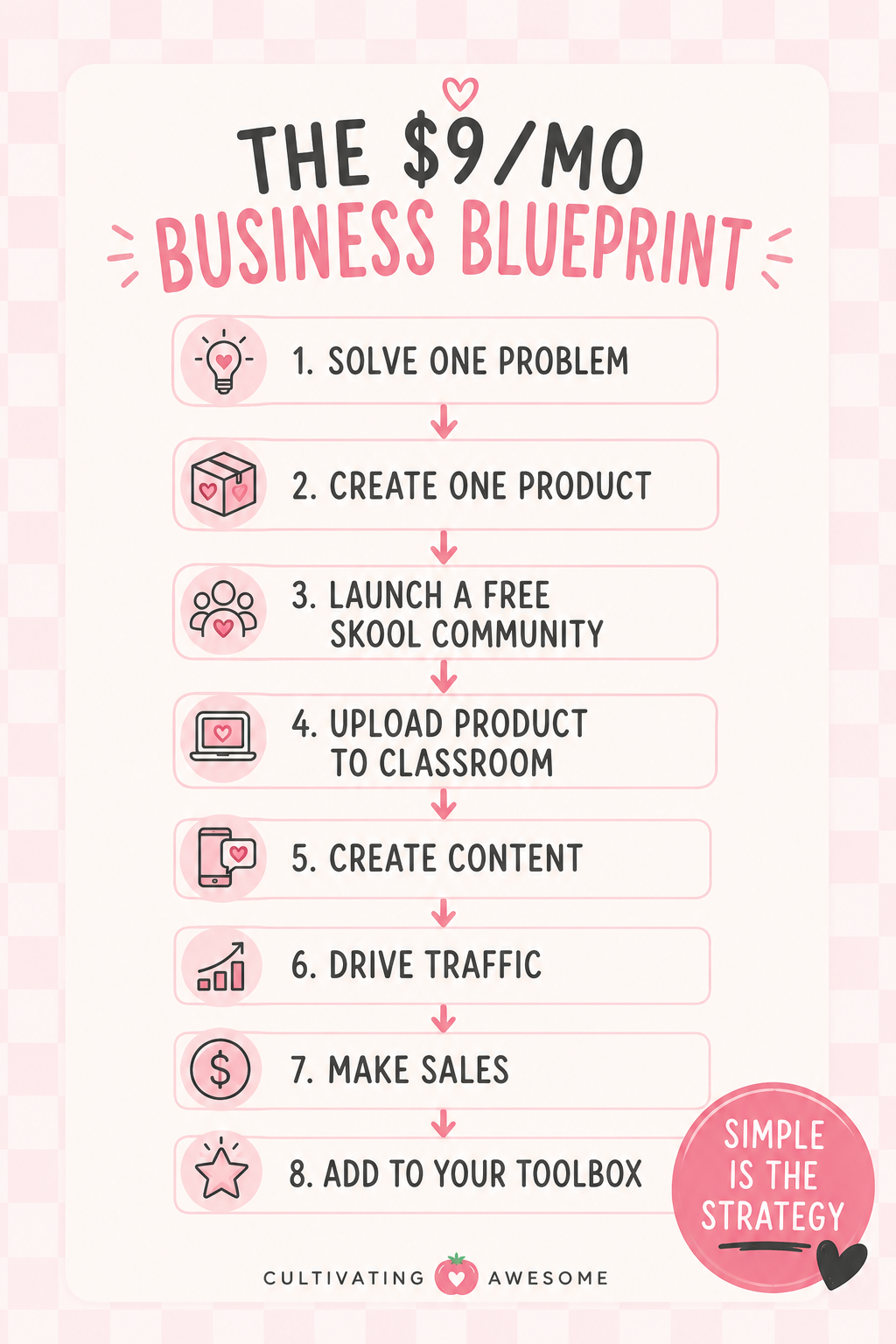
Everything else in this article simply expands on each step.
Step 2: Deliver It Through Skool
This is one of my favorite parts.
If your offer is a PDF...
Upload it into the Classroom.
If it's videos...
Upload them into the Classroom.
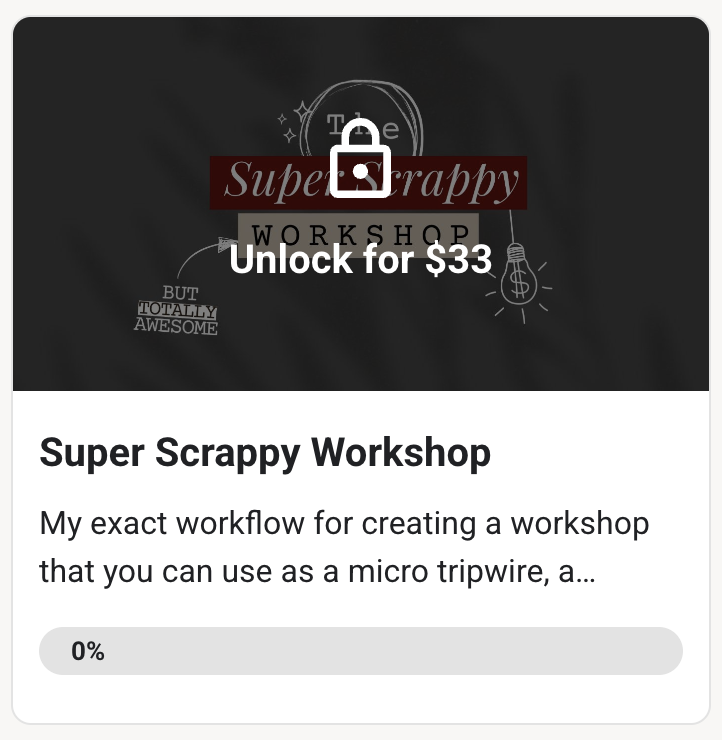
Charge a one-time fee for access if that's your business model. You can do this even if your Skool community is free, you can have individual classrooms be a 1 time payment to access.
No complicated delivery systems.
No automation headaches.
Here is an example of a one time fee in a classroom:
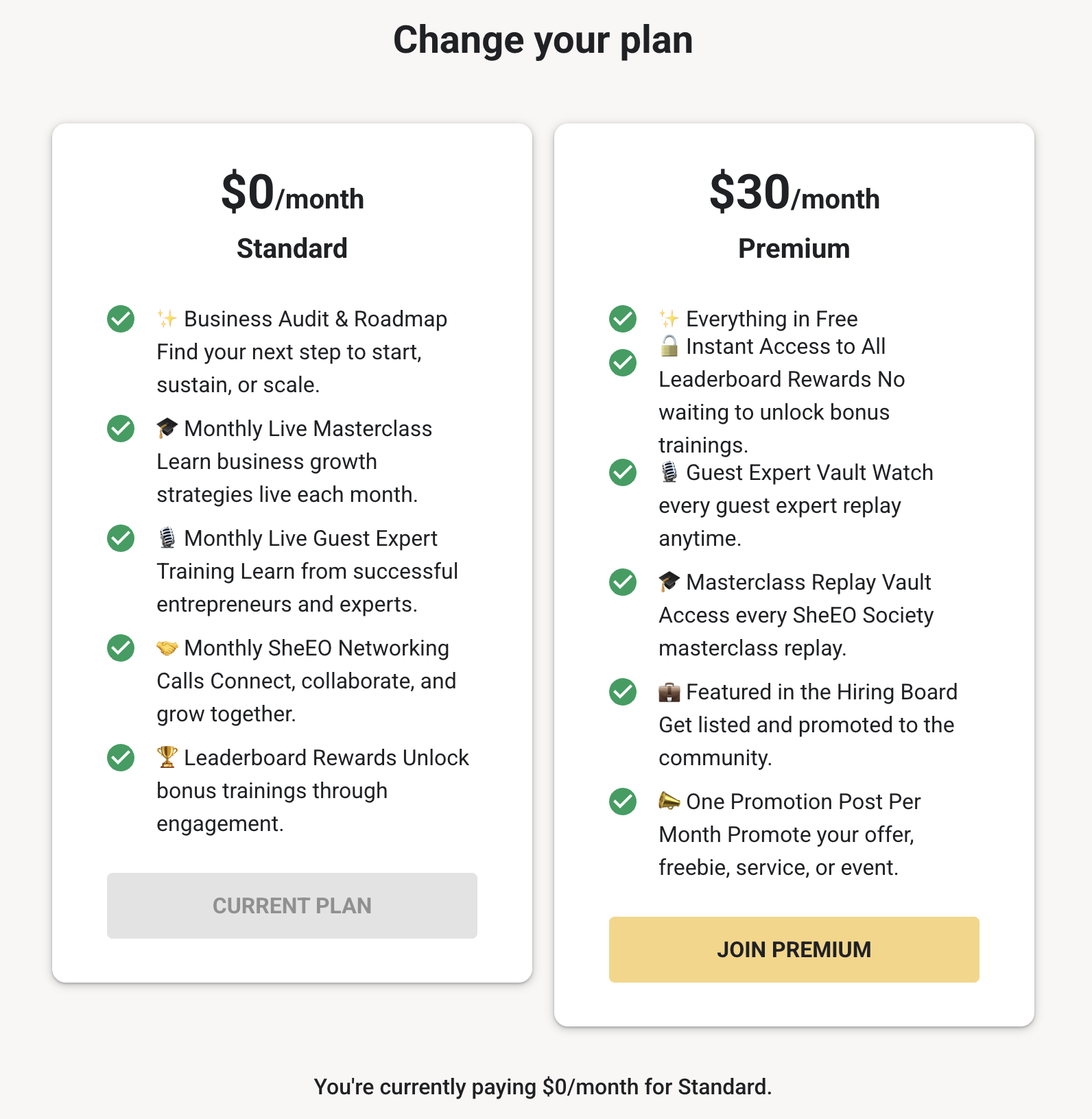
Here is an example of a paid community with an additional paid tier:
Pro Tip: Start With a Free Community
One of the smartest ways to grow is by creating a free community first.
Don't worry about charging on Day 1. Your first goal is to build trust with your first 50 members.
Answer questions.
Share wins.
Teach consistently.
Think of it like a Facebook Group... only way better (and not going to get shut down by bots like so many facebook groups have been lately).
Over time, you can introduce paid products inside your Classroom or eventually transition to a paid community if that fits your business.
What This Could Look Like in Real Life
Still not sure how this would work? Here are three simple examples.
Example 1: Budget Meal Planning for Large Families
You create a free Skool community called Budget Meal Planning for Large Families.
Inside the community, you share grocery savings, recipe ideas, pantry tips, and encourage members to post what's for dinner each week.
Inside the Classroom, you offer a one time paid upgrade with your monthly meal plans, shopping lists, freezer meal guides, or printable recipe binder. Or, you offer a free tier and a low price tier that includes the extras.
The free community builds trust.
The Classroom delivers the transformation.
Example 2: Homeschooling While Working Full Time
You create a free Skool community called Homeschooling While Working Full Time.
Inside the community, you share scheduling ideas, curriculum recommendations, encouragement, and answer questions from other working homeschool families.
Inside the Classroom, you sell a one time digital product with lesson plans, printable schedules, homeschool systems, or a complete toolkit for working parents.
Members join for the support.
Many upgrade because they want your complete system.
Example 3: Budgeting for Beginners
You create a free Skool community called Budgeting for Beginners.
Inside the community, you share money saving tips, budgeting wins, debt payoff encouragement, and answer members' questions.
Inside the Classroom, you offer paid resources like a budgeting workbook, debt payoff tracker, printable cash envelope system, or a complete beginner budgeting course.
Again, the community creates connection.
The Classroom delivers your paid products.
Notice the Pattern?
Every one of these businesses follows the same simple formula:
A free community around a topic people are already searching for.
⬇️
Helpful content that builds trust.
⬇️
A paid product inside the Classroom or an additional paid tier for people who want to go deeper.
You don't need a complicated website.
You don't need funnels.
You don't need ten different offers.
You need one clear problem to solve, one community that attracts the right people, and one product that helps them get a result.
That's it.
Complicated businesses don't scale. Simple businesses do.
Step 3: Skip the Email Platform (At First)
This surprises people.
To be clear, email is SO important, but you can skip out on the expensive software because Skool lets you send an email to all of your community members by publishing a community post and emailing it to members (currently up to once every 72 hours).
That means you can communicate with everyone without immediately paying for a separate email marketing platform.
As your business grows, you'll likely want a dedicated email system with more advanced automation.
But on Day 1?
Keep it simple.
Step 4: Get Traffic (Without Overcomplicating It)
At this point, you've done the hard part.
You've created your offer.
You've uploaded it into your Skool Classroom.
You've created a community around the problem you solve.
Now it's time to get people to see it.
This is where so many new entrepreneurs overcomplicate things.
They think they need a website.
A funnel.
An email sequence.
Five different lead magnets.
A link in bio tool.
And suddenly they're spending more time building systems than actually growing their business.
Once your offer is ready, the only job left is getting people to see it.
One of my favorite pieces of advice comes from Maria Wendt, who has built a wildly successful business selling low ticket digital products.
Her philosophy is simple:
One product. One link. One year.
I love this because it gives beginners permission to ignore the shiny objects.
Instead of creating five offers...
Create one.
Instead of sending people to five different places...
Send everyone to one place.
For me, that's your Skool About page.
Every Reel.
Every Pinterest Pin.
Every Instagram post.
Every TikTok.
Every YouTube Short.
Every piece of content points to the same destination.
Simple businesses are easier to stay consistent with.
Where Should You Get Traffic?
The good news is that you don't need to pay for ads when you're just getting started.
I recommend focusing on free content platforms like:
Instagram
Pinterest
TikTok
YouTube Shorts
Choose one platform you enjoy creating content for and commit to showing up consistently. Consistency beats platform hopping every single time.
Remember...
Your goal isn't to be everywhere.
Your goal is to become known somewhere.
One of the Biggest Advantages of Skool
Here's one of the reasons I recommend Skool over building a standalone website on day one.
You're not building your business alone.
You're joining an existing network of entrepreneurs and communities.
People discover new communities every day through Skool itself.
That means your community can receive organic traffic directly from the platform while you're also growing through your own content.
Most websites start with zero traffic. Skool doesn't. In fact, there are several networking communities where you can connect with other creators, build relationships, and (when allowed) share your own community.
Some of my favorites include:
Affiliate Disclosure: Some of the links listed are affiliate links. If you choose to purchase through them, I may earn a small commission at no additional cost to you. I only recommend resources I personally use, trust, or would confidently recommend to a friend.
For beginners, this built in ecosystem is one of Skool's biggest advantages over starting with a standalone website.
Instead of shouting into the internet hoping someone finds you...
You're building inside a platform full of people already looking for communities to join.
When Should You Upgrade?
Eventually, your business may outgrow this setup and you might want to expand to include a website and email marketing.
That's a good problem to have.
Once you're consistently making sales and your community is growing, then I'd start looking at a platform like GoHighLevel.
At that point, you'll probably want:
More advanced email automations
DM automations similar to ManyChat
A full website
Sales funnels
CRM features
More detailed reporting
But notice what I didn't say.
I didn't say you need those things to get started.
You need them when you've proven your business works... not before.
Earn the complexity.
✨✨The absolute lowest price you will ever find for GHL:
The best deal I've found is through Dan's Social Boom community.
At the time of writing (July 2026), members receive GoHighLevel for $147/year while also getting access to an incredible library of trainings from Social Boom, including:
The 10,000 View Challenge
AI Content Creator
AI Prompt Vault
10X Your Engagement in 10 Days Challenge
Viral Content Recipes
And many more content and marketing resources
I love this option because you're not just getting software.
You're joining a community that teaches you how to grow your audience while giving you the tools to scale your business.
The crazy thing is, this combined with Skool and you are still under $250/year combined. 🤯
My Recommended Beginner Tech Stack
Too many entrepreneurs build their tech stack before they build their business.
They spend months comparing platforms.
Watching tutorials.
Connecting software.
Designing websites.
Perfecting logos.
And never actually selling anything.
Meanwhile, someone else launches with one simple offer, one link, and one community... and starts making sales.
Guess who wins?
The goal of your first year isn't to build the perfect business.
The goal is to prove that people will pay for what you have to offer.
Everything else can come later.
If were starting over today, this is exactly how I'd build my business.
🌱 The Only Tech You Need:
Your goal is to make your first sales.
Here's what I'd use:
✅ Google Docs
Write first.
Design later.
Don't overcomplicate creation.
✅ Skool ($9/month or $90/year)
Everything you need to get started:
Your community
Your digital product delivery
Your sales page (About page)
Your classroom
Weekly email updates to your members
Payment processing for paid communities or digital products
✅ ChatGPT
For brainstorming, writing, editing, and creating content faster.
✅ Canva (Free)
For creating pins, social media graphics, PDFs, workbooks, and lead magnets.
✅ Free Traffic
Choose ONE platform and get really good at it.
My favorites are:
Instagram
Pinterest
TikTok
YouTube Shorts
Every piece of content points back to one place:
👉 Your Skool About page.
That's it.
No funnels.
No complicated websites.
No expensive software.
Keep it simple until your business starts paying you.
My Advice If I Were Starting Over Today
If I had to start from scratch with no audience and a limited budget, here's exactly what I'd do:
✅ Choose one problem to solve.
✅ Create one simple digital product.
✅ Launch a free Skool community around that topic.
✅ Upload my product into the Classroom.
✅ Share valuable content every day.
✅ Send everyone to one link: my Skool About page.
✅ Spend my money on learning and getting in front of people, not on software I don't need yet.
That's it.
Simple doesn't mean small.
Simple means focused.
And focused businesses tend to grow a whole lot faster than complicated ones.
If you're waiting because you think you need a website, an email platform, funnels, automations, and five different subscriptions before you can start...
This is your permission to do less.
Build the business first.
Add the bells and whistles later.
Stop waiting for someday.
Someday doesn't show up on your calendar.
Monday does.
Tuesday does.
Twenty five focused minutes today does.
Build the business you have time for now.
Then let it grow. 🍅
